Coastal vs. Interior: The Routing Decision That Distinguishes the Trip
Most premium Croatia itineraries are 100% coastal. The DMCs who insert one inland day into a coastal week ship the trip that gets remembered. Here's the routing math.
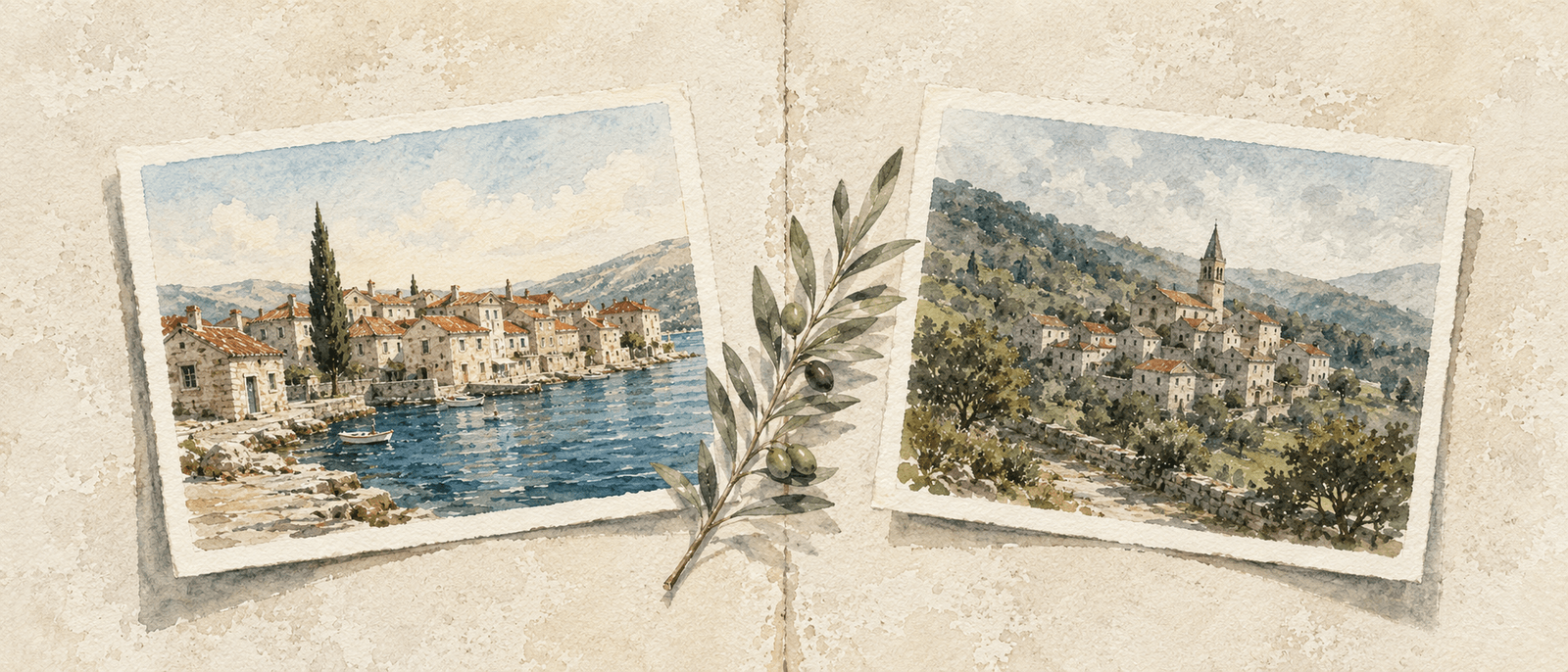
Almost every premium Croatia itinerary on the market right now is 100% coastal. Dubrovnik, an island, another island, fly home. It works — there's a reason it's the default — but it also produces a trip indistinguishable from every other premium agency's offering.
The DMCs whose Croatia trips get remembered tend to share one structural decision: they insert at least one inland day into the otherwise-coastal week. Sometimes more. The inland insertion isn't about being contrarian; it's about giving the coastal trip a visual and textural breakpoint that lets the rest of the trip register.
This article is about the routing decision. When to insert one inland day. When to split a week 50-50. When to go fully inland. And when to honor the client's coastal-only ask without modification.
The five routing patterns
Premium Croatia trips at year-three operations level break down into five routing patterns:
- Pure coastal. 100% on the coast and islands. The default. Right for first-time visitors, short trips (4-5 nights), beach-and-boat focused clients.
- Coastal + 1 inland day. A coastal week with one inserted inland excursion. Almost always Plitvice as a day-trip from the nearest coastal base. The most-recommended pattern for second-time Croatia visitors and trips of 6+ nights.
- Coastal + inland anchor (2-3 nights). A coastal trip with a multi-night inland stay attached. Typical: 4-5 coastal nights + 2-3 nights at a Plitvice farmhouse or a Zagorje castle. Right for clients who want a real change of register, not just a day trip.
- Split trip (50-50). Roughly equal coastal and inland time. Often Dubrovnik + Korčula + Plitvice + Zagreb. Right for returning visitors with 10+ nights who want two complete trips inside one calendar.
- Pure inland. 100% interior. Zagreb + Plitvice + Slavonia + Zagorje, no coast. Right for very specific clients — returning visitors with 'I've done the coast,' food-focused trips, off-season operations.
For most premium DMCs at year-three operations, the right distribution across these patterns is roughly: coastal 50%, coastal+1-day 25%, coastal+anchor 15%, split 7%, pure inland 3%. The DMCs whose distribution skews even more inland (more 50/50 trips, more pure- inland) are typically the ones whose returning-visitor rate compounds fastest.
When to insert one inland day
The single inserted inland day is the highest-leverage routing move in the DMC's toolkit. Costs nothing extra (the coastal base stays); takes one day out of the coast; delivers visual contrast that resets the trip's pacing for the days that follow.
When it works:
- Trip is 6+ nights
- Anything shorter doesn't have the room. A 5-night trip with a single inland day leaves 4 coastal nights, which compresses the coastal experience.
- Client has interest in nature, photography, or 'something different'
- Inland day usually = Plitvice. The visual contrast (limestone coast → forested lakes) is the entire payoff. Clients who'll appreciate that contrast are the right reader.
- The base is reachable from Plitvice within 2-3 hours
- Split is 2.5 hours from Plitvice; Zadar is 90 minutes; Dubrovnik is 4-5 hours. The Split-area trip works cleanly; the Dubrovnik-only trip stretches it.
- The client has 1 'flex day' they haven't filled
- If every day is already booked at the proposal stage with named activities, the inland insertion replaces something. If there's a flex day or a half-booked day, it slots in cleanly.
When it doesn't work:
- Trip is 5 nights or shorter
- Skip. Pure coastal is the right move.
- Client specifically said 'I want maximum beach time'
- Honor the preference. An inland day takes a day off the beach.
- Base is Dubrovnik and the trip is short
- The 4-5 hour drive to Plitvice makes a day-trip operationally heavy. Better to anchor the inland in a multi-night stay (pattern #3) or skip entirely.
- Client is age-vulnerable or mobility-constrained
- Plitvice involves 2-4 hours of walking on boardwalks. For some clients this is the trip's deal-breaker; better to skip.
How to position the inland day in the proposal
The single biggest reason DMCs don't include inland days isn't logistics — it's that they don't know how to sell them. Clients ask for Dubrovnik and Hvar; nobody asks for Plitvice. The DMC who proposes it has to introduce the idea.
Two framings that work:
The contrast framing
One thought on the day-4 structure: you're spending five days on the limestone coast (Dubrovnik, the boat day, Hvar), and the visual rhythm starts to blur a little by mid-week. I'd suggest taking day 4 off the coast and into Plitvice National Park — the inland lake-and-forest landscape is dramatically different, and the trip's remaining coastal days feel sharper after the break. It's a 2-hour drive each way from Split (or a private transfer with stops); we'd be back at the hotel by 18:00 for dinner.
The framing names the reason (visual rhythm), proposes the specific day (day 4), names the operational reality (drive time, back by 18:00). Clients almost always accept this proposal because the rationale is clear.
The depth framing
Quick note on Plitvice: it's in most Croatia top-10 lists for a reason — but the day-tripper version (4 hours in the park, herd of tourists) misses what makes it specific. I'd structure your visit as an early-morning arrival (gates open 07:00; the first 90 minutes are nearly empty), and stay at a small farmhouse 20 minutes from the park entrance instead of one of the chain hotels. Two nights gets you the morning at the lakes, an afternoon back at the farmhouse, dinner at a working konoba, and a second-day walk through the upper lakes when the day-trippers are concentrated on the lower ones.
The depth framing positions the inland stop as a premium experience, not a checkbox. Clients who want to feel like they're getting access — not just a stop on a list — respond strongly to this framing.
The split-trip (50-50) routing
A split trip allocates roughly equal time to coastal and inland Croatia. Typical structure for 10 nights:
- Days 1-2 — Zagreb arrival. The inland anchor. Hotels, food, architecture.
- Days 3-4 — Plitvice / Lika. The icon + the surrounding farmhouse stay.
- Days 5-6 — Transit + Dubrovnik arrival. Drive south (with a Krka National Park or Šibenik stop) or short flight.
- Days 7-9 — Coastal stretch. Dubrovnik + boat day + one island stay.
- Day 10 — Departure. Out of Dubrovnik.
Or the inverse: start coastal (because the warm-weather energy is right for the trip's opening), drift inland for the second half. The order matters less than the split itself.
Right reader for split trips:
- Returning Croatia visitors
- Done a full coastal trip last time; now they want both halves.
- 10+ night trip durations
- Anything shorter doesn't have room for both halves to register.
- Architecture / food / history-focused clients
- The inland half delivers more of these than the coastal half does, so the split trip optimizes for them.
When to keep it purely coastal
Not every trip benefits from inland insertion. The unambiguously-coastal cases:
- First-time Croatia visitors on 5-7 night trips
- They came for the imagery they've seen. Deliver that, in its best version. Save the inland for trip two.
- Beach-and-boat focused trips
- Sailing trips, yacht-based trips, families primarily wanting swim time. The coast is the entire point.
- Honeymoon trips with a romantic coastal register
- The coastal sunset-and-bay-table register is what the trip is for. Inland would shift the emotional tone.
- Off-season or shoulder coastal trips
- The coast in May or September delivers everything a coastal trip is for, without the high-summer crowd problems. Inserting inland is structurally unnecessary.
- Repeat clients who specifically loved the coastal previous trip
- If they're returning specifically because the coast delivered, change-the-trip is the wrong reflex. Refresh it with different coastal stops instead.
The supplier question
A DMC who routes coastal-only over and over builds a coastal supplier network — drivers, guides, restaurants, boat captains — and never needs an inland one. The first inland insertion requires sourcing a Plitvice guide, a farmhouse stay, an inland driver. The fifth inland insertion uses the same suppliers; the network compounds.
The implication: don't add inland to a single trip in isolation. Add it to a small batch (3-5 trips over a season) and use those trips to build the relationships. By year two, the inland supplier network is mature enough that inland insertions cost the same operational time as coastal blocks.
The conversion economics
DMCs who consistently insert inland days into otherwise- coastal trips report two compound effects:
- Higher retention rate. Returning-visitor trips are easier to design (the coast is already known), and clients who experienced the inland insertion in trip 1 ask for more of it in trip 2. The repeat client conversation gets richer.
- Higher per-trip revenue at year three. The split-trip and coastal+inland-anchor patterns are typically 15-25% larger trip-value than pure coastal (more nights, more transit logistics). The DMC who normalizes these patterns ships higher-revenue trips on the same client volume.
The cumulative effect over 2-3 years is meaningful. The DMC operating year-three at 50% coastal-only / 25% coastal+1-day / 15% coastal+anchor / 7% split / 3% pure-inland ships a different book of business than the DMC at 95% coastal-only / 5% other. Same destination, same operational base, materially different revenue and retention profiles.
The short version
Most premium Croatia itineraries are 100% coastal; the ones that distinguish insert at least one inland day. Five routing patterns: pure coastal (default for short trips and first-timers); coastal + 1 inland day (the highest-leverage move on 6+ night trips); coastal + inland anchor (2-3 nights inland for clients wanting real change); split trip (50-50 for returning visitors with 10+ nights); pure inland (specific clients only). Position the inland day in the proposal via the contrast framing or the depth framing; expect high acceptance. Build the inland supplier network in a batch of 3-5 trips, not one at a time. Year-three DMCs who normalize inland insertions ship trips with higher retention rates and higher per-trip revenue than peers who stay coastal-only.
The decision is small per trip and large in aggregate. A DMC adding one inland day to 30% of their trips over three years builds a meaningfully different business than one who never does. Same destination, different trips, different outcomes.